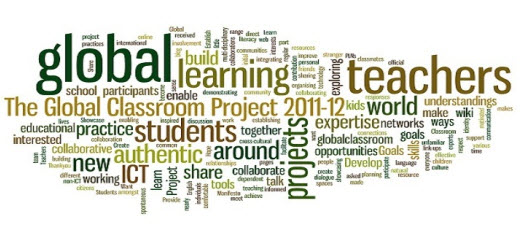
The Global Classroom Project: Building Commmunity

We’re always interested in programs that help teachers and their students connect with each other.

So when I heard about the Global Classroom Project I asked Michael Graffin to write a blog post to tell us more.

About the Global Classroom Project

The Global Classroom Project was co-founded by Deb Frazier (@frazierde) in Ohio, USA, and Michael Graffin (@mgraffin) in Perth, Western Australia.

Since its humble beginnings in April 2011, #globalclassroom has evolved under the leadership of @mgraffin into an online learning community, connecting teachers and students around the world.

This is our story.

When we began our 2011-12 Project, we had some goals in mind:

  • We set out to help teachers improve their classroom practice, through collaborating and sharing expertise with teachers around the world …
  • We set out to create a community which fosters global dialogue and discussion between teachers and students …
  • We wanted our students to have regular opportunities to share, learn and collaborate with children around the world, helping them to discover our common humanity …

Global Classroom Manifesto

And we are succeeding beyond our wildest dreams …

We now find ourselves running a global educational network involving hundreds of teachers, and thousands of students, across 32 countries and 6 continents.

Our wiki, blog, Facebook, and Skype groups have proved to be  vibrant online spaces for teachers to connect, share, and collaborate globally …

And, to our astonishment, the monthly #globalclassroom Twittter chats, created by @mgraffin,  became the world’s first global education chats, open to all teachers interested in flattening their classroom walls.

We’ve created a global community.

We have succeeded in creating a true educational community, where teachers support each-other’s learning. find new friends, and make global connections which transform their teaching and learning spaces in unexpected and empowering ways.

Where else can you find a teacher in remote Nepal connecting his students with the world?

Or the teacher in Taiwan whose classroom has been transformed through her Skype connections and conversations with teachers worldwide?

Where else can you find such an amazingly diverse group of people, from all walks of life, who are keen to connect, share, and collaborate with you?

This is impacting on our students too …

Our teachers have created opportunities for their students (of all ages) to learn, share, and work with children around the world – through Edmodo, Skype, Wikis, VoiceThread and Flat Stanley exchanges.

We are teaching our students, through real-life connections, how to connect and collaborate globally; and who knows what impact this will have later in life?

Kids Speak 2011-12 (@frazierde)

And yet, this is just the beginning …

When we launched Global Classroom 2011-12 last year, we had no idea where it would ultimately lead. The connections, the learning, and the sharing amongst our members  has been astonishing, and the opportunities this project has afforded continue to surprise and inspire its creators.

Our 2011-12 project runs through to June 2012, and we look forward to sharing our members’ projects and students’ learning over the months to come.

If you’d like to join us, please join our wiki and fill out the registration form for your year level. You’d be most welcome.

Find Us Online:

Blog:             http://theglobalclassroomproject.wordpress.com
Wiki:              http://globalclassroom2011-12.wikispaces.com
Facebook:    http://facebook.com/groups/globalclassroom

Twitter:           Use the #globalclassroom hashtag

Skype:              Send a contact request to mgraffin, and ask to join the group
VoiceThread:  Send request to @frazierde (or email debfrazier4@ gmail.com)

About the Author

This guest post was written by Michael Graffin from Perth, Western Australia. He blogs at mgraffin.edublogs.org, and tweets as @mgraffin.

He co-founded The Global Classroom Project with Deb Frazier, from Ohio, USA. Deb blogs at Primary Perspective, and tweets as @frazierde.

Conversations, Community and Open PD

Image of the faciliators from Open PDOnce weekly I attend Open PD facilitated by Robin Ellis, Darren Draper and Kelly Dumont.

Today’s session — an introduction to blogging — I was invited to share tips on blogging which I decided to expand on a couple of tips by following up with this post.

About Open PD

Open PD is an open staff development course that any teacher, administrator, or technology specialist can join to learn more about the many free, online tools that can be used to enhance your teaching.

Image of Open PD LogoClasses are held once weekly, in five week blocks, with the global participants joining the face-to face participants in Utah, USA using Skype, Ustream and the Open PD wiki. I, like many others, throughly enjoy, and gain so much, from joining these weekly sessions.

Image of blog conversationsTip #1 – Remember The Conversation

The most important aspect of blogging, and where the true learning happens, is in the conversations. Always keep sight on how to achieve this conversation!

Conversations happens when you write a reflective post that invites / encourages / evokes readers to express their opinion:

  • Readers post their comments in response
  • You respond back with your own comments to your readers comments
  • If your post, or the comments, invokes sufficient emotion readers expand on their responses in their own post, which will link back to your original post
  • And you may follow up your original post with what you have learned from the comments and other posts

Sue Wyatt’s Creating a classroom blog is a classic example of the importance of blogging as a conversation. Sue has just started out blogging and asked for help working out how to blog with students. After reading her post I asked:

Blogging conversation like these are powerful because you are drawing from a diverse range of people, from various backgrounds, with a variety of experiences. Each individual shares their differing perceptive leading to greater gain and innovation by all involved.

My personal recommendation is for educators to first start out blogging for themselves; so they gain an understanding of how important these conversations are for the learning process.

Tip #2 – You Are Building a Community

Can’t take credit for this tip! Oops, I had forgotten to talk about the significant of community building in blogging – thankfully Jamie Gustin reminded me.

Conversations happen when you take the time to build a sense of Community. Readers will go out of their way to help and assist you; if they feel part of your community.

Make time to:

  • Engage with your readers on your own blog; post comments in response to theirs to show you value their input.
  • Visit and comment on other people’s blogs. Blogging isn’t about staying home; it’s about visiting others, engaging in their conversations and taking the time to help them with their learning. Showing you care about others means they are more likely to take the time to help you.

I’m very effective at managing my comments on other people blogs using co.mment — which tracks my comments, and notifies me automatically by sending the comment to my Google Reader account. This way when a person comments on a post that I have commented on I can choose to immediately respond back if I want.

FINAL THOUGHT

The next series of Open PD session start in 2 weeks (5 March) and is available to any one who wants to attend; contact Robin or Darren via the Open PD wiki for more information.

What tips and advice would you give educators who are new to blogging? How do you explain the value of blogging?

If you are enjoying reading this blog, please consider Subscribing For Free!